ROYAL NAVY 1952 TO 1964.
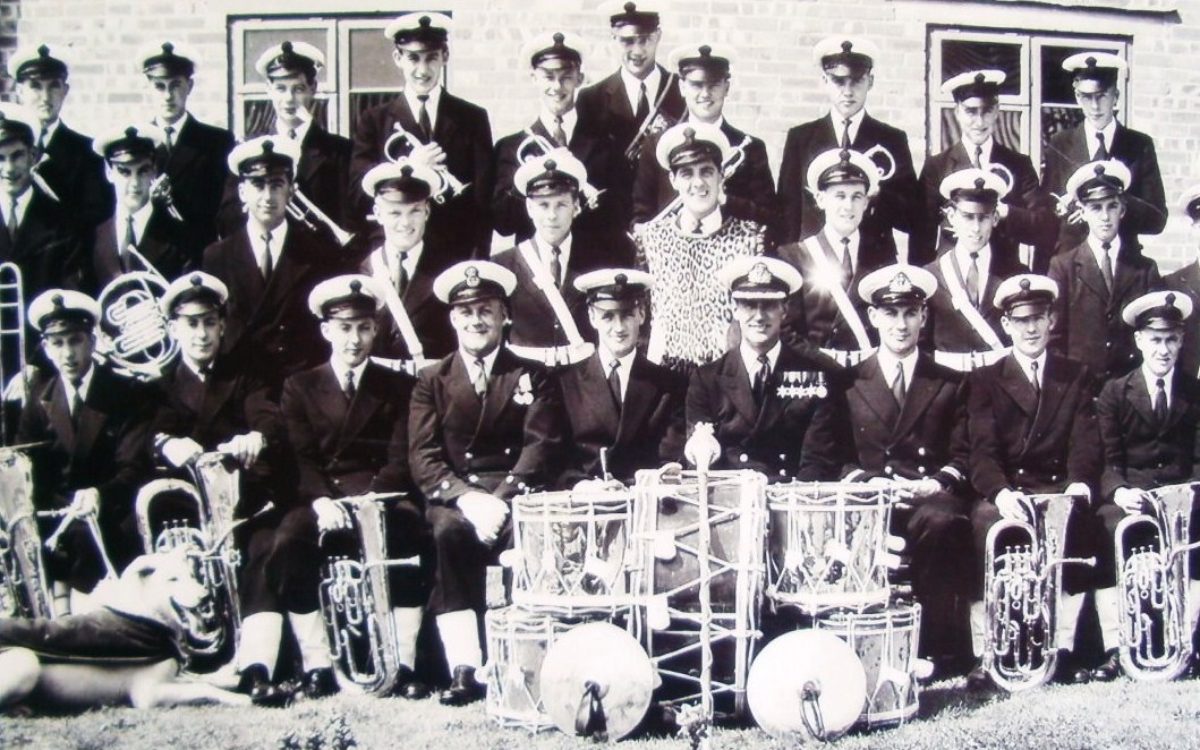
I then joined HMS Fisguard in Torpoint Devon for 1 year in 1952 on workshop training I mention this because at the time it appeared so easy. We were first given a sheet of metal to make a square hole in. Then a solid metal piece to fit neatly in it all ways around. Sounds easy but its not as many found out with bits being thrown on the floor in frustration and having to start again. After that we worked on Lathes, Milling machines and Shappers completing our training with Gas and Argon Arc welding and Copper Smith working. I was then posted to HMS Collingwood in Fareham taking a 3year course in Electrical Engineering.During this time I joined the band which had its perks. Notably you were excused duties and could spend more weekends at home. We would often play at fetes etc giving us the chance to enjoy good food and meet the local ladies. On one occasion I remember the band leader throwing his stick up in the air and falling over a small hill disappearing from view. My most memorial and indeed an honour was playing in the band at the Royal Albert hall for Field Marshall Montgomery Desert Rats El Alamein reunion.
MIDDLE ROW 4 FROM END. BARRY WEST BOTTOM ROW 3 FROM RIGHT.

During this time I bought my first motorbike a Matchless 350 cc. I remember my dad saying it was too big.
Picture of me outside our house. I really enjoyed those days because there was very little traffic on the roads. I would pick up a friend Jonny Freeman from Horsham railway station and he would fall asleep for most of the journey back and I would wake him up when we arrived. I always wore a big flying suit and when I got back to the dormitory would take this off and have my pyjamas underneath and go straight to my pit(Navy term for bed) I mention this because a lot of my mates who joined up with me back in 1952 have a get together in the Red Lion pub Southwick and often remind me of this.
My first ship was HMS Corunna a Battle Class destroyer one of the 4th Destroyer squadron. The other ships in the squadron were HMS Agincourt, Barossa and Alamein.. In 1956 we were in the Suez Canal when Egypt’s President Gamal, Abdel Nasser nationalized the Suez Canal and were the last ship to leave. The next day Israel invaded Egypt and remained until March 1957.
I was very fortunate in that I went into the Artificers mess made up of Radio, Engine Room, Electrical, Shipwright and Ordinance engineers. The Chief Artificers had their own mess. During this time my best mate was Mike Oliver nicknamed Olly and we always went ashore together. In Malta we would anchor in Sliema Creek and get on one of the many small boats called Dysos to get ashore. There was a well known Naval song called “Not for me but for my Dyso”. We would go down the well known Strait street nicknamed the GUT which was full of bars from one end to the other. There was also another GUT called the Floriana but this was never as busy as Strait street. There were very few women which resulted in heavy drinking by many sailors and I remember being in charge of a Naval Patrol with an armband picking up those who had too much to drink and returning them to the ship to sleep it off.
It was a great honour for me because the ship was captained by Charles Godfrey Place VC,CB,CVO,DSC. He won this when he was only 22 years old in 1943 when he and his 4 man crew of the midget submarine X7 along with Lt Donald Cameron VC of X6 carried out a raid on the German battleship Tirpitz placing 4 charges under the ship as she lay at anchor in Kaafjord in Norway rendering her unfit for sea until 1944. They were both captured and spent the rest of the war in Coldizt. Where he played a part in the celebrated “Albert RN”.
He was a remarkable person and when he was released from Coldizt he joined the Fleet Air Arm and qualified as a pilot in 1952 and served as a Squadron Commander in the carrier Glory in the Korean war. He was then commander of the destroyer Tumult followed by being the executive officer of the Carrier Theseus and then Captain of my first ship above HMS Corunna.He was a very laid back person and when at sea would wear casual clothing usually a tartan shirt as did a lot of the ships company. On one occasion we were exercising with the US Navy and they sent us a signal. Who are all those civilians standing round the smoke stack? His reply they are not civilians they are the ships company.He then commanded the frigate Rothesay as Captain (F)6th Frigate squadron followed by being the captain of HMS Ganges and then the Commando Carrier Albion in the Far East until he was promoted rear-admiral in 1968.At that time he was the only serving VC in the Navy. All his medal collection are at the Imperial War Museum. He retired in 1970 and died in 1994. A truly remarkable man.

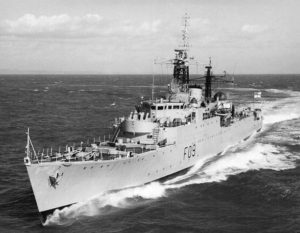
HMS Corunna was one of the last heavily armed Destroyers with two 4.5inch (114mm) guns on the bow and another aft. In addition it had 8 Bofor 40mm guns and 2 rows of 5 21inch Torpedoes amidships and 2 Squid Mortars at the rear of the ship plus 2 machine guns amidships.
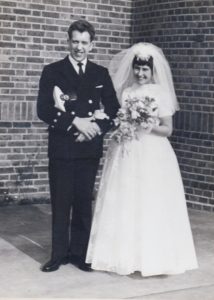
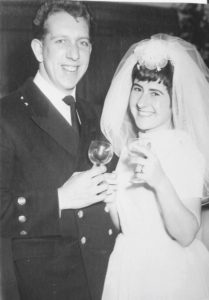
In 1961 Danie and I were married with Danies sister a bridesmaid and Keith Ronaldson my best man. He boxed for the RN and I remember going to see him fight a well known boxer McTaggert. Danie and I knew his mum and dad who most times had a paint brush in one hand and a glass of beer in the other.
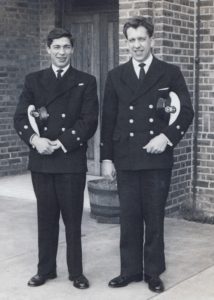
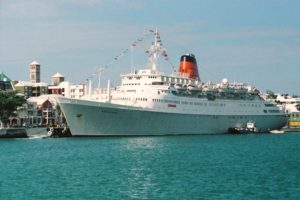
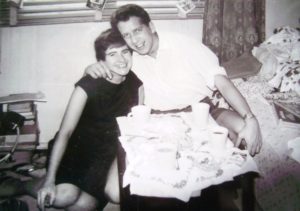
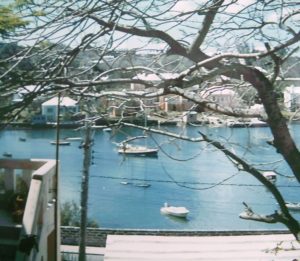
I then joined HMS Troubridge (often associated with the Navy Lark which was on TV at the time.) Some of you may remember it with John Pertwee and Leslie Philips and the well known saying left hand down a bit . The ship was stationed in Bermuda on Hurricane Patrol. Danie came out to join me. We lived in a very small house with a lovely view of the harbour and the houses which by law had to be pastel coloured with all the roofs painted white. There were no rivers in Bermuda and every house had water tanks on the roof. The police force were all British and were very noticeable with pale blue shirts, and dark blue Bermuda shorts. No bikinis were allowed on the open beaches and if the police caught any girls with them on were very crafty enforcing the law and asking for their names and where they lived.

It was a wonderful start for us especially as it was our first Christmas together, but I did spend a lot of time at sea on hurricane patrol. One hurricane I will always remember was Hattie. It hit Belize, British Honduras in October 1961 with winds of 140 to 180 mph. It was horrific, there were dead bodies everywhere and over 400 people were killed and more than 10,000 made homeless. We spent many days with the local police, soldiers and other helpers burying the dead including 100 who had stupidly taken shelter in a church which was overcome by a 12ft storm surge. The river was never ending with bloated dead bodies,cattle,horses etc and when they reached the open sea there were bodies everywhere with frenzied sharks eating them.
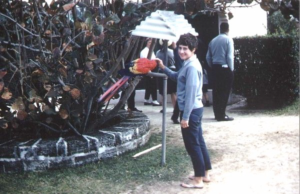
Our next port of call in 1962 was Bridgetown, Barbados where the CIA had funded strikes and riots resulting in many houses being knocked down and often set on fire including the harbour. (See enclosed picture) The people were mainly Indians and governed by Cheddi Jagan a long time Marxist and there Leninist who was also closely associated with Fidel Castro of Cuba. In 1964 outbursts of violence escalated beyond the control of the Authorities and the Government declared a state of emergency. British troops were rushed in to restore order. After that a new election took place and was won by Forbes Burnam of the National Democratic party who led the country for the next 20 years.
We next went into dry dock in San Juan Puerto Rico to clean the bottom of the ship. I was amazed at the many roads crossing each other in such a small area. I spent a lot of the time walking around the town because there was so many interesting things to see. There was also an American PX store that sold everything and I bought a very nice camera for my brother Jimmy who had previously asked for one. There was a massive swimming pool where we played water polo against the American Navy. I cant remember the result but I won the 50yd Breast Stroke and still have the video of it as a reminder.
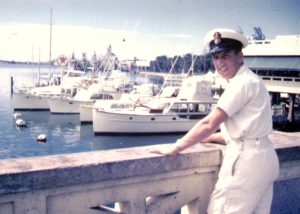
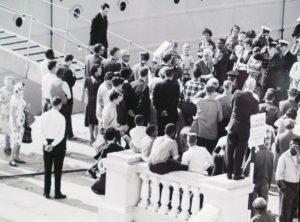
Nearing the end of my tour in1962 the Bermuda Conference took place with Harold McMillan and J.F.Kennendy of the USA. Nearing the end of our tour in 1962 the Bermuda Conference took place with Harold McMillan and J.FKennedy of the USA. McMillan toured the ship and gave a speech. Below is a picture of him leaving and I can be seen saluting right hand side behind the policeman.
In 1963 I was posted to HMS Collinwood in Fareham for a years course on Radio, Radar and Meteorological Equipment. Once again I joined the band meeting up again with my mate Barry West. One occasion I will never forget was mustering on the parade ground for a visiting Admiral. I was playing in the band with Barry when it became very hot and the order was given Off Jackets. Unfortunately I had my white shirt and tie on but my shirt was cut off at the elbows. I told Barry and pretended to be faint and he helped to carry me off. During this time I was going out with Danie and thought about buying a Lotus sport car. Her response was that’s it then, but all ended happily ever after we got both. The car was very fast with a Laycock de Normaville Overdrive. Many cars wanted to overtake me and be first away at traffic lights which I gladly let them do.
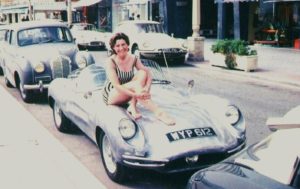
We first flew with the car from Lydd to Le Tougue then drove down to Nice and Cannes spending most of the days on the beach and exploring the night life in the evenings. On our next visit we drove to Dover and caught the ferry to Calais, then a creepy overnight stop in Chalonnes Sure Loire near Rheims where previously there had been the most horrific murder of a whole family. The next day we drove over the mountains and down to St Tropez as shown in the pictures. This was to be our last holiday together without the children. Driving back to UK in Reims the half shaft of the cars right rear wheel broke. Luckily we had stopped by a garage and I asked the owner if I could leave the car outside. I had insurance cover and decided to go back home to get a new one when a man in a Rover stopped and asked if he could help. I explained the situation and he said he would gladly take us back because we were staying at Danies parents house and he was going that way. He was a delightful man and tuned out to be Lord Cadbury. I had a spare shaft at home which I took back and fitted the next day. In 1964 I was posted to one of the very last Navy Cruisers HMS Lion which set sail the next day to the German port of Kiel. We tied up alongside the Tirpitx Mole for “Kieler Wocher or Kiel week.This was which a renowned occasion similar in a way to our Cowes week. It was badly damaged during the Second World War and rebuilt into a fine modern port with the spire of its ancient church of St Nicholas, the patron of seafarers dominating the skyline. The official reception was a great success, and Beating Retreat by the Royal Marines was much appreciated by the 300 official guests. Being a big ship the 12 hour passage out through the Kiel Canal to the North Sea was difficult and we had to have seamen on both sides of the ship guiding us through. We then visited the island of Hay near the wartime anchorage of Scapa Flow. As we steamed through the Flow the ship piped a salute to the ill fated battleship Royal Oak as we passed by her resting place.
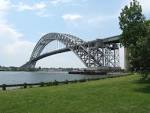
Soon after we went to the USA sailing up the Potomac river and under the Bayonne bridge(one of the world largest and longest.) to New York. In the city all Military personnel in uniform were given free bus passes and theatre tickets. Every Sunday there was the well known Ed Sullivan show and in February 1964 a date I will always remember because it was the first visit of the Beatles to the USA.
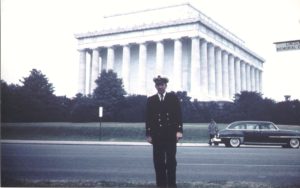
It was fully booked but there were a few tickets available for Military Personnel and I was one of the lucky ones. I still remember a couple of their songs.(I want to hold your hand and She loves you.)Apparently the broadcast had 37 million listeners. After that I visited the Lincoln Memorial in Washington DC and then went up the coast to Charleston, South Carolina a city where the old rest easily along with the modern as quoted by Americas most-published etiquette expert Marjabelle Young Steward. Charleston in 1995 was said to have been the best mannered city in the USA. I certainly noticed this, the people were kind and helpful and would go out of their way to talk to you about there past history. Originally the town was named Charles Towne Landing. There is a 17th century village typical of what the original settlers might have constructed and also a 53-foot replica of the trading ketch “Adventure” a vessel typical of what the young colony would have used to trade commercial goods foodstuffs and even livestock between New York and the West Indies. Fort Sumter fired the first shots of the American Civil War on April 12th 1861 when Confedarae artillery opened fire on the Federal fort in Charleston harbour. Fort Sumter surrendered 34 hours later.
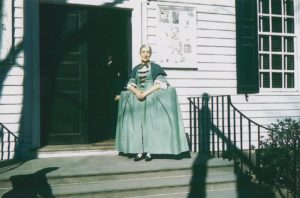
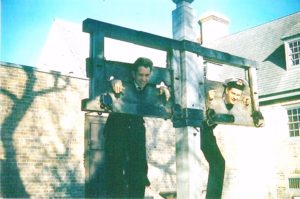
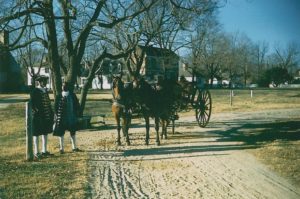
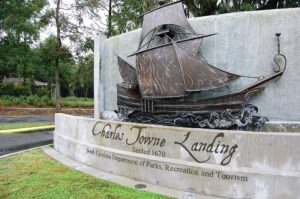
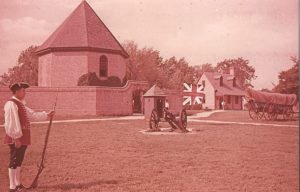
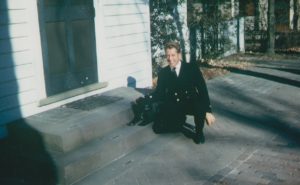
CHARLESTON SOUTH CAROLINA
Founded and settled by English colonials in 1670 Charleston grew from a colonial seaport to a wealthy city by the mid eighteenth century. Through the nineteenth the economy prospered due to its busy seaport and the cultivation of rice,cotton and indigo. In April 1861 Confederate soldiers fired on Union soldiers who occupied Fort Sumpter in Charleston harbour thus signalling the beginning of the Civil War. Charston was slow to recover from the devastation of this war. However its pace of recovery became the foundation of the City’s greatest asset the vast inventory of historical significant architecture. Short of capital after the war Charleston was forced to repair its existing buildings instead of replacing them. After the war the city gradually lesson ed its dependence on agriculture and rebuilt its economy through trade and industry. Construction of the Navy Yard in 1904 just north of the city bounderies pushed Charleston vigorously into the twentieth century. During the first few decades the industrial and other activities increased dramatically. Later major sources of capital came from the Naval Base,the areas medical industry and tourism. Today approximately 4.51 million people visit the city annually creating an estimated 3.22 billion Dollars.
John Thomas Boone an Indian trader, received the land known as Boone Hall Plantation as a grant from the Lord Proprietors in 1681. The Boones began growing indigo, and thus began a long history of providing crops for the South Carolina low country. The Horlbecks, architects who designed and built many buildings and landmarks in Charleston, purchased the plantation in 1800. They manufactured bricks and started commercial pecan production. The plantings became known as the worlds largest pecan groves in the early 1900s.
Thomas Stone a Canadian bought the plantation in the early 1930s He built the present house and planted crops such as cabbage, potatoes and tomatoes shipping them overseas .Harris McRae who came to Boone Hall plantation just before the Second World War bought the crops from many growers in the area and loaded them onto flat bottomed boats in the Boone Hall docks to Charleston Harbour where they were shipped to Philadelphia and then by road to New York. After the war he returned to continue the business and purchased the plantation in 1955. Unfortunately operations ceased in 1989 due to Hurricane Hugo. In 1996 William McRae resumed production with a 3 acre pick your own Strawberry operation. He later added peaches tomatoes and vegetables. Today the farming operation is known as Boone Hall Farms specializing in meats, local seafood and specialty produce.

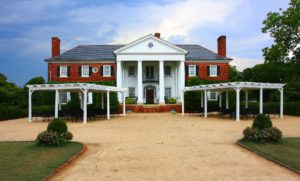
Moss on the trees up to “The Mansion”.
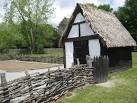
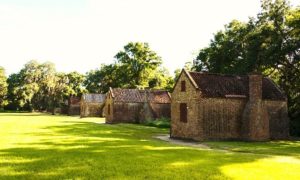
Barn & Barn house Building 1800
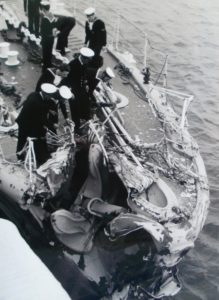
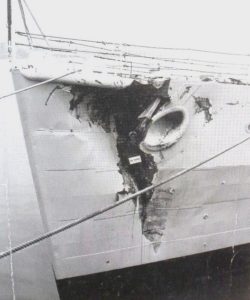
Soon after that we went to Scotland where the Queen was to open the new Forth Bridge, but in the fog our ship was rammed by HMS Lowestoff and we ended up going to Malta for repairs. Danie came out with our four month old son Marcus and that ended my 14 years in the RN and I enjoyed every day of it!
HMS Corruna was a floating gun ship. It had two 4.5-inch(114mm) guns on front and one at the rear.Bofor 40 mm guns. 2 rows of five 21-inch Torpedo Tubes amidships with 2 Squid Mortars at the rear.